Breaking Down Good Will Hunting: The Power of Vulnerability, Overcoming Fear, and the Avoidant Mind
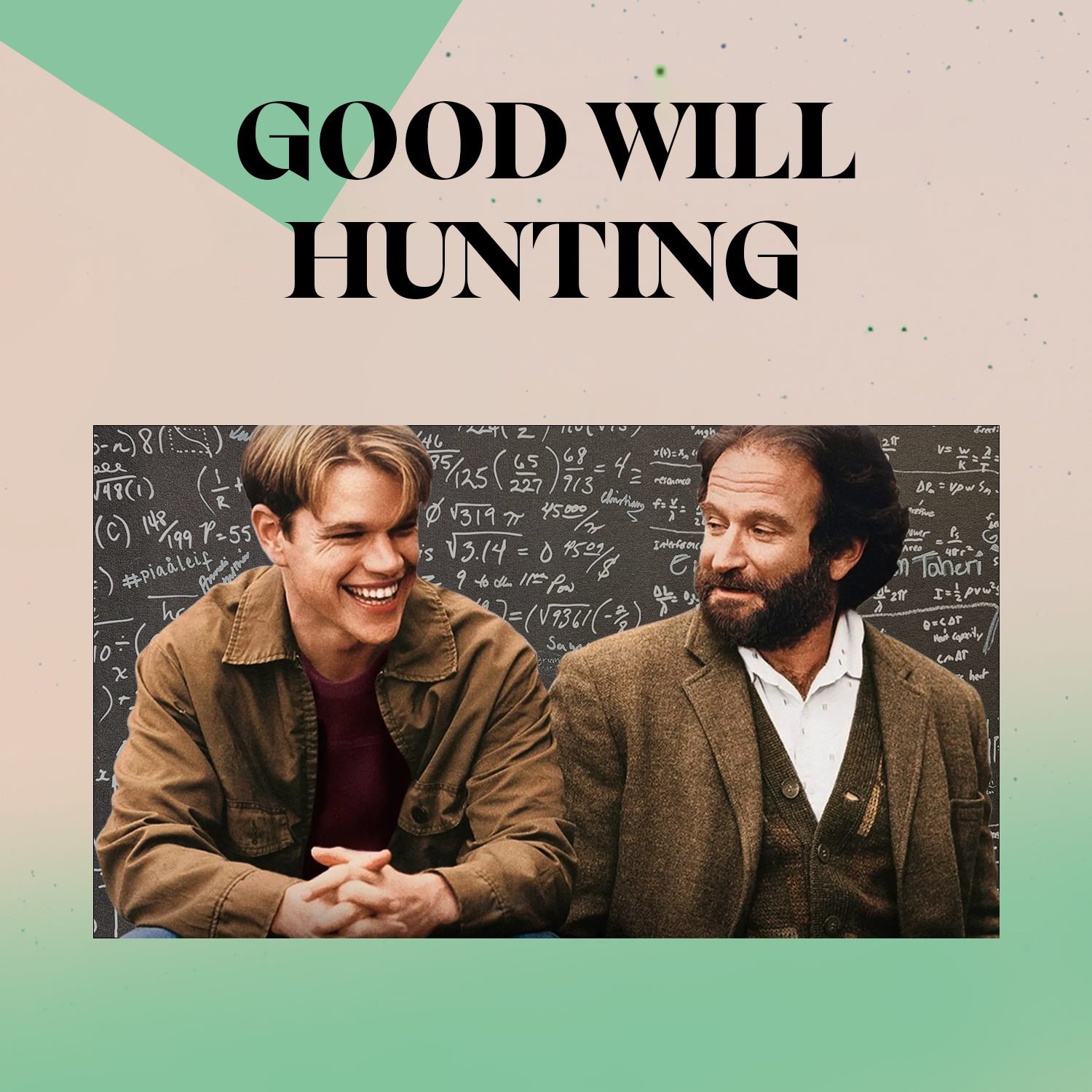
Good Will Hunting (1997), directed by Gus Van Sant, is a psychological drama that gained recognition not only for its performances but above all for its sensitive exploration of trauma, fear of intimacy, and the therapeutic process. The film won two Academy Awards for Best Original Screenplay (Matt Damon and Ben Affleck) and Best Supporting Actor (Robin Williams).
It’s worth noting that while the film’s accolades are impressive, at its core, Good Will Hunting is a story about finding one’s own path and confronting what hurts the most. Though often described as a story about extraordinary talent, genius turns out to be almost secondary, a facade masking the real focus on vulnerability and fear.
The film offers a profound exploration of how defense mechanisms shape a person’s life and how they can hinder growth and connection.
The protagonist, Will Hunting (played by Matt Damon), is an incredibly intelligent young man with astonishing mathematical abilities. He works as a janitor at MIT, solving complex problems in secret, while his personal life remains marked by a deeply traumatic childhood. Years of abuse and neglect have left him emotionally guarded and wary of intimacy.
Will displays classic insecurities and avoidant tendencies rooted in this trauma. He instinctively pushes people away the moment they get too close, relying on humor, hostility, and intellectual dominance to protect himself from vulnerability.
These strategies allow him to maintain control, but they also sabotage his relationships, most notably with Skylar. His fear of abandonment is so deeply rooted that he prefers to leave first rather than risk being left.
It’s worth noting that Sean Maguire (played by Robin Williams), who is the court-ordered therapist of Will Hunting, refuses to be impressed by Will’s intelligence or cultural knowledge and tries to see what’s behind the facade.
Sean confronted Will with a simple but uncomfortable truth: knowing facts is not the same as knowing oneself. He saw that Will uses his intellect as a shield, believing that if he knows more than everyone else, he can control the situation and stay safe. He realizes that Will is hiding behind books to avoid being truly seen. In their most pivotal encounter, Sean delivers a speech that challenges Will to drop the act:
“You're an orphan, right? Do you think I'd know the first thing about how hard your life has been, how you feel, who you are, 'cause I read Oliver Twist? Does that encapsulate you? Personally, I don't give a sh-t about all that, because you know what, I can't learn anything from you I can't read in some f--kin' book. Unless you want to talk about you, who you are. Then I'm fascinated. I'm in. But you don't wanna do that, do you, sport? You're terrified of what you might say. Your move, chief.”
This moment highlights the core of Will's struggle. He uses his facade to dismiss others before they can get close enough to hurt him.
Sean’s challenge is simple but devastating: all the books in the world can’t replace the vulnerability of an actual conversation. By calling him "scared," Sean points to the fact that Will’s intellectual superiority is actually a survival technique for a boy who has never felt safe.
“I look at you, I don’t see an intelligent, confident man. I see a cocky, scared, shitless kid, but you’re a genius, Will, no one denies that“
Sean Maguire breaks through Will’s defense mechanisms to change him for the better. Over the course of eight therapy sessions, we see a subtle examination of fear and how, if you let it, it can constrain your potential and push you away from what you really want.
By confronting his deep-seated fear of abandonment, Will slowly learns to heal and finally allows himself to pursue what he truly desires.
1) Intellectual Armor & Avoidant Mind of Will Hunting
“Sean: "I'd ask you about love, you'd probably quote me a sonnet. But you've never looked at a woman and been totally vulnerable. Known someone that could level you with her eyes, feeling like God put an angel on earth just for you."
The very opening shot tells us a lot about Will’s character. He lives alone in a single, dark room with the blinds pulled tight, shielding him from the outside world as he indulges in what he secretly loves: reading. This visual metaphor sets the stage for everything that follows.
Director Gus Van Sant chose not to show Will’s life through conventional methods, instead using a unique kaleidoscope effect during the opening credits. This gives the viewer the impression that Hunting is a complicated person made of many fragments. It is up to us to put those pieces together and slowly discover who he really is.
Despite his extraordinary intelligence, Will spends his time drinking with friends, going to batting cages, and getting into fights. The first twenty minutes of the film are deceptively quiet, immersing us in a world where nothing truly changes. South Boston functions as a protective bubble, familiar and predictable, where Will shields himself from the pain of the unknown.
The turning point comes when Will is arrested for assault. Facing jail time, Professor Lambeau intervenes, and the court allows Will’s release under the condition that he solves mathematical equations with Lambeau and attends therapy. For Will, this arrangement provides a "safe excuse" to test his potential. By being forced into therapy by the court, he relieves himself of personal responsibility. If it fails, it wasn't his choice to be there.
However, Will’s inherent distrust of authority, rooted in his history of abuse and foster care, makes him a difficult patient. He doesn't see therapy as an opportunity for growth, but as a game to be won. This is clear from his very first meeting with Sean Maguire, where Will ignores every attempt at a normal introduction:
“Sean: How are you? Where are you from in “Southie?” Will: I like what you’ve done with the place. Sean: Thanks Will: Do you buy all these books retail and you send away for like a shrink kit that comes with all these volumes included?“
Will uses this sarcasm to belittle Sean’s professional standing and intellectual life, but his most aggressive defense appears when he spots a painting Sean created. He uses his sharp perception to ruthlessly attack Sean’s weakest point:
“Will: Maybe you’re married to a lifestyle. Maybe you married the wrong woman. What happened? Did she leave you? Or maybe she was sleeping around?”
This is a classic defensive move. By projecting his own fears of abandonment onto Sean, Will attempts to level the playing field. He intentionally tries to hurt the therapist, hoping to be kicked out so he can return to his safe isolation.
Interestingly, there is a grain of truth in Will’s attack. Sean has closed himself off after his wife’s passing, stopping all emotional risks. In many ways, Sean is undergoing his own "therapy" while leading these sessions. This stagnation is evident after their first encounter, when we see Sean sitting alone in his messy apartment, drinking whiskey.
Even though Will has mastered the art of intellectual evasion, his body often betrays him. He smokes compulsively when the conversation becomes too personal or when his defenses are challenged. There is a deep, tragic irony here: the man who was burned with cigarettes as a child now uses them to calm himself down. Will is so accustomed to pain that he prefers controlled self-destructive behaviors and the safety of predictable suffering over the uncontrolled fear of rejection, a pattern that later sabotages his relationship with Skylar.
Will’s avoidant tendencies serve as a fortress that keeps him "safe" but also completely stagnant. His intellect is not a tool for growth, but a sophisticated security system designed to keep the world at a distance. He believes that if he remains a riddle that no one can solve, no one can ever truly hurt him.
2) Overcoming Fear
“Sean: Maybe you're perfect right now. Maybe you don't wanna ruin that.“
To deeply understand Will’s journey, we have to look at the relationship between his actions and his emotions. His avoidant tendencies are essentially a survival strategy. While the previous chapter focused on the "armor" he wears, this chapter explores the fear that makes that armor feel necessary. Avoidance is the symptom, but fear is the root cause.
This is most apparent when Professor Lambeau discovers Will writing on the chalkboard and confronts him. Instead of claiming his genius, Will runs away because he is terrified of being perceived. To Will, wanting more out of life feels like a betrayal of the identity he has built with his loyal friends. This loyalty to his "Southie" roots and his fear of change are highlighted during a heated argument between Sean and Lambeau:
“Sean: Gerry, listen - Why is he hiding? Why doesn't he trust anybody? Because the first thing that happened to him was that he was abandoned by the people who were supposed to love him the most! Lambeau: Oh, come on, don't give me that Freudian crap! Sean: And listen, Gerry, why does he hang out with those retarded gorillas, as you call them? Because any one of those kids would come in here and take a f**king bat to your head if he asked them to. That's called loyalty! Lambeau: Oh, that's nice-- Sean: And who do you think he's handling? He pushes people away before they have a chance to leave him. It's a defence mechanism, alright? And for 20 years, he's been alone because of that. And if you push him right now, it's going to be the same thing all over again. And I'm not going to let that happen to him! “
Sean realizes that Will surrounds himself with people who offer physical protection and unconditional acceptance, things he never had as a child. His friends don't require him to be a genius. They just love spending time with him.
In contrast, Will holds a deep resentment toward the academic world. He fears that if he enters that elite space, he will be rejected or exposed as an imposter. He lies to himself about his desires because staying in his safe bubble is easier than risking failure in the real world.
Sean Maguire identifies this logic immediately. He sees that Will uses dead philosophers as a shield because they are safe. During a session about soulmates, Will tries to deflect again:
“Sean: You feel like you're alone, Will? Will: What? Sean: Do you have a soulmate? Will: Define that. Sean: Somebody who challenges you. Will: Chuckie? Sean: No, Chuckie's family. He’d lie down in fucking traffic for you. No, I'm talking about someone who opens up things for you, touches your soul. Will: I got— I got... Sean: Who? Will: I got plenty. Sean: Well, name them. Will: Shakespeare, Nietzsche, Frost, O'Connor, Kant, Pope, Locke. Sean: That's great. They're all dead. Will: Not to me, they're not. Sean: You don't have a lot of dialogue with them. Will: Not without some serious smelling salts and a heater. Sean: Yeah. That's what I'm saying. You'll never have that kind of relationship in a world where you're always afraid to take the first step because all you see is every negative thing ten miles down the road.”
Will chooses dead authors because they cannot reject him or judge him. This is the core of his avoidance: he is so afraid of a negative outcome "ten miles down the road" that he refuses to take the first step today. That is what fear does. It allows you to stay comfortably miserable. Will chooses dead authors because they cannot reject him or judge him. They do not require him to risk his heart. This fear of the "first step" is what keeps him stuck.
To break this cycle, Sean takes Will out of the office to a lake. He delivers a powerful monologue explaining that while Will is brilliant, he lacks life experience. He knows the words, but not the feeling. He challenges Will to stop hiding.
Sean: "I can’t learn anything from you I can’t read in some f--kin’ book. Unless you wanna talk about you, who you are. Then I’m fascinated. I’m in. But you don’t wanna do that, do you, sport? You’re terrified of what you might say. Your move, chief."
This challenge and attempt to open up to Will triggers a defensive silence that lasts for weeks. This is where we see another layer of Will's avoidance: the use of silence as a weapon. For several sessions, Will and Sean sit in complete stillness, neither of them saying a word.
Will eventually tell Sean about his first date with Skylar. He admits he is afraid to call her back because, in his mind, she is "perfect", right now. He fears that if they meet again, he will discover her flaws, or she will discover his. Sean dispels this fear by telling a story about his wife's imperfections. He explains that knowing someone's flaws and continuing to love them is what makes a relationship beautiful. The only way to find real love is to face the fear head on.
However, Will’s insecurities and fear reach their peak later in the film, during his breakup with Skylar. This scene is the most honest and painful moment in the film. The use of a handheld camera makes the scene feel raw and uncomfortably close, as if we are trapped in the room with them.
Will: What do you wanna know? What? That I don't have 12 brothers? That I'm a fuckin' orphan? No, you don't wanna hear that. Skylar: I didn't know that. Will: No, you don't wanna hear that. You don't wanna hear that I got fuckin' cigarettes put out on me when I was a little kid. That this isn't fuckin' surgery. That the motherfucker stabbed me. You don't wanna hear that shit, Skylar! Skylar: I do wanna hear that. Will: Don't tell me you wanna hear that shit! Skylar: I wanna hear it because I wanna help you, because I wanna be with you. Will: Help me? What the fuck! What do I got, a fuckin' sign on my back that says, Save me?
Will pushes her away before she has a chance to leave him. He interprets her offer to help as a sign that she sees him as "broken." His history of abuse in foster care created an inherent distrust of anyone who tries to get close. To Will, being "saved" feels like an insult.
Later, we see a powerful visual contrast. When Skylar is at the airport, she looks around, hoping Will will show up. Instead, the film cuts to Will sitting alone on a park bench, watching planes leave. This parallel editing shows their shared pain.
At this point, Will is still choosing the safety of his walls over the risk of being loved. He remains a prisoner of the belief that it is safer to be alone than to be seen.
And that’s what fear does. It allows you to stay comfortably miserable.
3) The Power of Vulnerability
“Sean: You don’t know about real loss, ’cause it only occurs when you’ve loved something more than you love yourself.“
Previously, we mentioned Will’s avoidant tendencies and fear. And if those tendencies were the armor and fear was the reason he wore it, then vulnerability is the act of finally taking that armor off. For Will, strength was always defined by invulnerability. He mastered the ability to deflect pain and stay detached, believing that by hiding, he was winning.
However, Maguire completely redefines this concept, showing Will that what he thought was strength was actually a cage.
This transformation is complicated by the presence of two conflicting father figures: Professor Lambeau and Sean Maguire. They represent the two sides of the internal war Will is fighting.
Throughout most of the film, Lambeau represents conditional worth. He sees Will’s potential and wants to fit him into an elite narrative of academic prestige. This only creates more pressure because Lambeau’s approach does not address Will’s core purpose. To Will, Lambeau’s world feels like a trap where his value is tied only to his results. It triggers Will’s fear of being an imposter.
It’s worth mentioning that Lambeau is not a villain. He genuinely wants the best for Will and truly cares about his future. However, he goes about it in a way that only adds more pressure. During the previously mentioned heated argument with Sean, Lambeau expresses his deep fear for the boy’s future:
“Lambeau: This is a disaster, Sean. I brought you in here because I wanted you to help me with a boy. Not to run him out. I don’t care if you have a report with the boy. I don’t care if you have a few laughs even at my expense, but don’t you dare undermine what I’m trying to do here. This boy is at fragile point right now. Sean: I do understand. He is at fragile point right now, okay? He’s got problems Lambeau: Oh, what problems does he have, Sean? That is better off as a janitor, that is better off in jail, better off hanging out with a bunch of retarded gorillas?“
Sean Maguire, however, offers the revolutionary gift of unconditional presence. By accepting Will even when he is aggressive, silent, or cruel, Sean breaks the cycle of conditional acceptance. He proves to Will that he matters simply because he exists. This creates the safe harbor necessary for vulnerability. At first, it was unfamiliar to Will that he was not judged and that someone just accepted his existence.
This leads to a crucial realization about Will’s presence at the university. Will claims he wants to be invisible to stay loyal to his "Southie" story, but his actions betray a subconscious desire to be found. Sean exposes this during their confrontation:
“I'm sure that's why you took that job. I mean, for the honor of it. I just have a little question here. You could be a janitor anywhere. Why did you work at the most prestigious technical college in the whole fucking world? And why did you sneak around at night and finish other people's formulas that only one or two people in the world could do, and then lie about it? 'Cause I don't see a lot of honor in that, Will. So what do you really want to do?”
Sean forces Will to confront the massive contradiction in his life: he claims to hate the "intellectual elite," yet he purposefully placed himself in their temple. This reveals that Will’s avoidance was never about a lack of ambition, but about a paralyzing fear of his own greatness. He was hiding in plain sight, hoping someone would be smart enough to see through his mask.
This question strips away Will’s last defense. He didn't choose MIT to hide. He chose it because, deep down, he was looking for a way out of his own self-imposed cage. He was leaving breadcrumbs for someone to find the real him, not just the genius.
As we previously mentioned regarding the silence in therapy, Sean challenges this by saying, “Your move, chief.”
Will treats life like a poker game and refuses to play unless he has a perfect hand. He is afraid to take risks because he might lose. Sean is the first person who does not need Will’s genius, is not afraid of his attacks, and does not leave when Will tests boundaries.
The breakthrough happens because Sean uses his own vulnerability. By sharing the story of his late wife’s funny imperfections and his decision to miss a historic Red Sox game just to meet her, he teaches Will that true intimacy is worth the risk of pain. Sean shows that vulnerability is not a weakness or a loss of control, but the only bridge to real life. Will finally realizes that his traumatic past is not his fault, and his defense mechanisms begin to fall when he allows himself to feel pain instead of just analyzing it.
By witnessing Sean's willingness to be "imperfect" and still find peace, Will finally understands that he doesn't have to be a perfect genius to be worthy of love. He begins to realize that the "perfect hand" he was waiting for doesn't exist, and the real game of life is played in the messy, uncertain moments of connection.
The character of Will Hunting shows that true transformation only begins when one stops hiding to avoid exposing one's own vulnerability.
4) "It's Not Your Fault."
"People can’t believe in themselves until someone else believes in them first." — Sean Maguire
For the majority of the film, Will is a prisoner of his own history. He carries the trauma of his abusive childhood, believing deep down that the abuse happened because there was something wrong with him. This shame drives his every move.
He instinctively sabotages good things before they can flourish. To Will, staying in South Boston isn't just about loyalty to his roots. It’s a way to avoid the risk of failure in a world where he feels he doesn't belong.
The turning point occurs during his final session with Sean. Sean looks at Will’s file and sees the photos of the physical abuse Will suffered. He realizes that Will knows he was a victim intellectually, but he has never accepted it emotionally. This leads to the most famous scene in the movie, where Sean repeats, "It's not your fault."
Sean: It’s not your fault. Will: I know. Sean: No, you don't. It’s not your fault. Will: I know. Sean: It’s not your fault. Will: "Don't f--k with me. Not you. Sean: It’s not your fault.
At first, Will brushes it off with a casual "I know," hiding his pain, but Sean persists, invading Will’s defensive space and repeating the phrase again and again. Will’s anger flares, his survival instinct fighting to keep the walls up. He is terrified to let go of the guilt because, in a strange way, guilt gave him a sense of control. If it was his fault, he could have changed it. If it wasn't, he was just a helpless child.
As Sean refuses to back down, Will finally breaks. He releases decades of repressed pain, and the "bad boy" facade from Southie disappears, revealing the hurt child underneath. This is the moment when Will stops punishing himself. It’s the emotional heart of the story. Will cannot move forward because he doesn't believe he deserves to. By accepting that the trauma was not his burden to carry, he finally puts down the shield. He is no longer glued to his old identity of the "unwanted orphan." The release of guilt finally opens up the space for a real choice.
However, healing is not just about crying. It’s about action. Throughout the movie, Will’s best friend, Chuckie, tells him he is sitting on a "winning lottery ticket" but is too afraid to cash it in. Chuckie gives him the most honest speech in the film:
Chuckie: "Look, you're my best friend, so don't take this the wrong way. In twenty years, if you're still livin' here, comin' over to my house to watch the Patriots games, workin' construction, I'll f--kin' kill ya. That's not a threat, that's a fact. [...] The best part of my day is for about ten seconds, from when I pull up to the curb and when I get to your door, 'cause I think, maybe I'll get up there and I'll knock on the door and you won't be there."
Chuckie doesn't want Will to leave to be a “rich hotshot.” He wants him to leave because he knows Will can be happier. He wants Will to stop playing it safe. Self-sabotage and avoidance are always fueled by overthinking. Will can solve the world’s hardest equations, but fear and comfort zones kept him paralyzed when it came to his own life. The fact that Sean stuck around and didn’t abandon him, even when tested, provided the stable base Will needed to finally stop overthinking and start living.
In the final scene, Will chooses the risk. His friends gift him a beat-up car, a symbol of freedom and their unconditional support. Faced with a choice between a prestigious, safe job and a massive leap into the unknown, he chooses the latter. He leaves a note for Sean that says: "I had to go see about a girl." This mirrors Sean’s own life-defining decision to miss the World Series to meet his wife. In this moment, Will chooses love and adventure over safety.
The film ends with Will driving down an open highway toward California, a clear sign that he has let go of his defenses. We don’t know if Skylar will take him back or what his career will be, and that is the point. For the first time, Will is not defined by his past, his fear, or his genius. He is stepping out into the unknown, armed with the knowledge that he is enough.
The visual journey of the film perfectly encapsulates this transformation: it begins with Will alone in a dark, cramped room and ends with him driving on an open road.
This shift represents the movement from a fixed, safe point to an infinite, uncertain, but ultimately free trajectory. By accepting that his past was not his fault, Will heals his wounds, lets go of his fear, and finds the courage to chase a future filled with hope.
Summary
Good Will Hunting is not just a story about a math genius, but a profound exploration of the war between fear and potential, a struggle that is ultimately addressed through two pivotal monologues that dismantle Will's emotional defence mechanisms.
The first of these is Sean Maguire’s park bench speech, where he deconstructs the idea that knowledge can ever replace experience. He points out that while someone can quote sonnets and history books, they haven't truly lived until they have been vulnerable enough to experience life.
The second monologue is delivered by Chuckie, whose "ten seconds" speech serves as one of the most selfless acts of friendship. Chuckie sees a friend who is scared and settling for far less than he is truly capable of. By telling Will that the best part of his day is the brief hope that Will has finally moved on to a better life, he challenges the fear that prevents Will from reaching his true potential.
Both Sean and Chuckie recognize that Will’s refusal to take chances is what truly holds him back from a life of meaning. Their interventions serve as a powerful reminder to address your past wounds and finally embrace the act of living.
This film encourages us to resolve our inner struggles and move forward with purpose rather than staying stuck in a safe but stagnant existence.
If you found this article intriguing or are interested in collaborating, feel free to connect with me on Twitter or visit my personal website.