Exploring Henri Bergson: Intuition, Élan Vital, and the Philosophy of Life — History of Philosophy #6
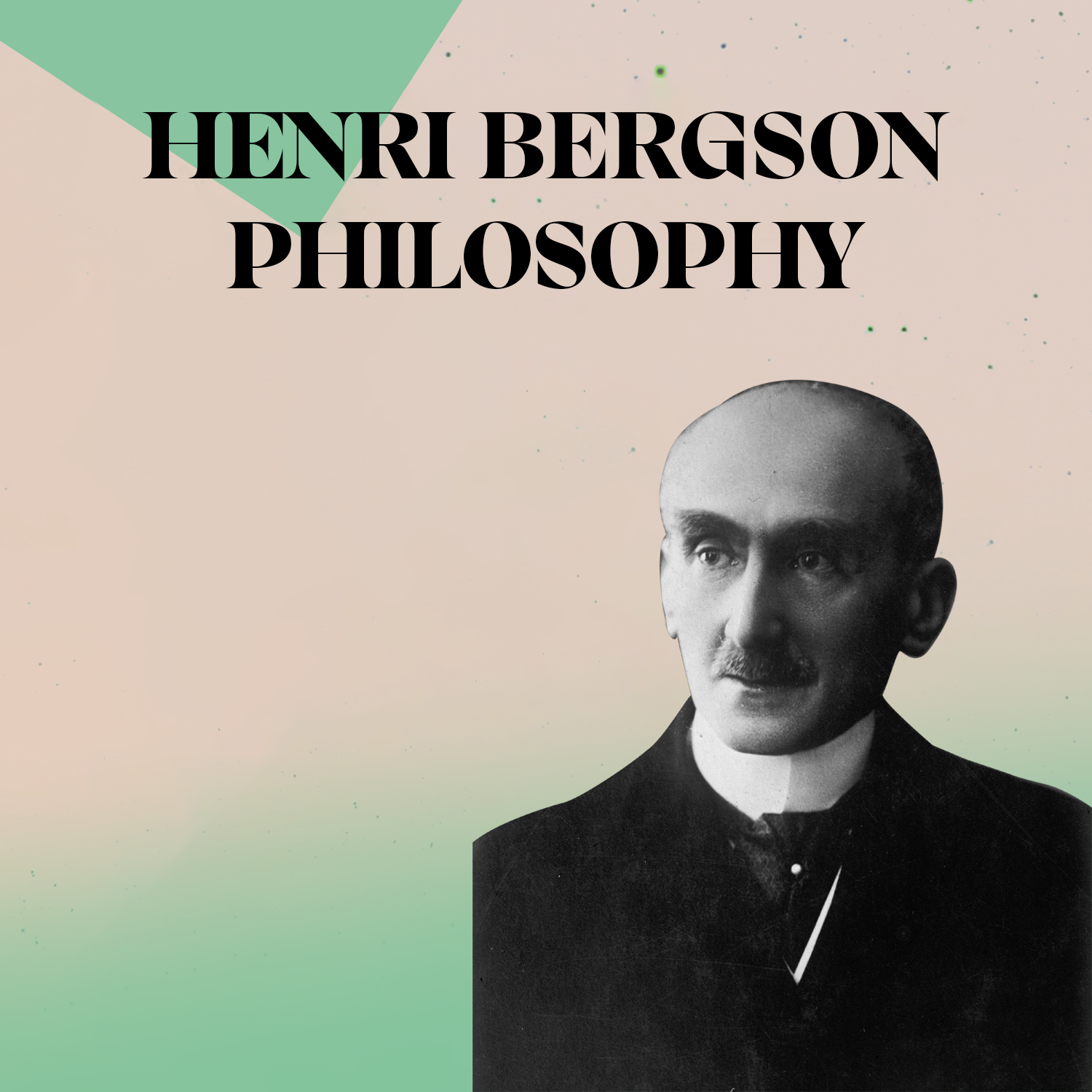
Henri Bergson was a French philosopher and a key figure in philosophical intuitionism, who won the Nobel Prize in Literature in 1927. He was born in Paris, but spent his early childhood in England. At the age of nine, his family returned to France. His father was a Polish Jew who had left Warsaw as a child during the November Uprising, while his mother came from a family of English and Irish Jews.
Bergson studied at the École Normale Supérieure in Paris. For several years, he taught philosophy in high schools, both in the provinces and in Paris. In 1889, he earned his doctorate, and he became a professor. In 1900, he was appointed to the chair of philosophy at the Collège de France. His original ideas, developed in successive works, along with his exceptional skill as an orator, brought him widespread popularity.
“To exist is to change, to change is to mature, to mature is to go on creating oneself endlessly.”
A distinctive feature of his work was the way he combined traditional philosophical questions with contemporary scientific knowledge. He conducted inquiries at the intersection of philosophy and fields such as biology, neurology, and psychology, focusing in particular on questions related to human thought and the experience of the world.
To understand Bergson’s philosophy, one might compare it to the workings of a film camera: successive frames, projected rapidly, create the illusion of continuous motion. Similarly, Bergson argued, the human mind perceives the material world in a static, intellectual way, but the spiritual essence of reality is dynamic and can be grasped only through intuition. This vital, creative force, which he called élan vital, is the source of life’s ceaseless evolution and creativity.
It is worth mentioning that Bergson’s lectures were famously attended by devoted audiences, with ladies sending their servants hours in advance to reserve seats, while students often had to stand. His critics accused him of anti-intellectualism, inconsistency, and an overly literary approach to philosophical issues. Yet Bergson emphasized that life is a continuous flow of experiences and actions, guided not by rigid reasoning but by intuition, and that freedom is the highest value.
The French philosopher’s ideas did not remain confined to academic philosophy. They resonated widely with artists and writers, shaping early modernist thought. Marcel Proust, the French novelist best known for “In Search of Lost Time,” regarded him as a great metaphysician. Early modernist poets and artists saw him as a major authority alongside Schopenhauer and Nietzsche, inspiring movements such as futurism, symbolist literature, and the development of the stream-of-consciousness technique. Bergsonism, a literary current shaped by his philosophy at the turn of the 19th and 20th centuries, emphasized intuition over rationalism, the creative life force, and the limitations of language in capturing the continuously changing reality.
Bergson and Nietzsche are often regarded as two of the most important thinkers of modernism. Both rejected the doctrines of their predecessors, and their skepticism was part of a search for new ways of understanding. They sought to explain the cultural crises of their time, albeit in different ways. Nietzsche, criticized for his provocative theses and uncompromising style, aimed to reevaluate all established values and to challenge mediocrity and weakness. Bergson, on the other hand, emphasized irrational intuition and returned to metaphysical inquiry. Both spoke of life in terms of a vital force: Nietzsche’s “will to power” and Bergson’s “élan vital“ represent a creative energy that drives human evolution and gives meaning to existence.
The most important works of the French philosopher include “Matter and Memory” (1896), “Creative Evolution” (1907), “The Creative Mind” (1919), and “The Two Sources of Morality and Religion” (1932). These works lay the foundation for understanding Bergson's philosophy, which bridges traditional metaphysics with contemporary insights into life, consciousness, and creativity.
1) Inspirations
“My initiation into the true philosophical method began the moment I threw overboard verbal solutions, having found in the inner life an important field of experiment.“
Henri Bergson’s philosophy grew out of a deep dissatisfaction with purely intellectual ways of understanding reality. At its core lies a fundamental opposition between intellectual knowledge and intuitive knowledge. While the intellect analyzes, divides, and fixes reality into static concepts, intuition allows us to grasp life as it truly is: dynamic, continuous, and creative. This distinction underlies many of Bergson’s key ideas, including the contrast between the superficial self shaped by social habits and language, and the deep-seated self rooted in inner duration and freedom.
Bergson understood freedom not as making rational choices between options, but as acting from one’s deeper self. Freedom appears when action grows naturally from inner experience, rather than from external rules or fixed ideas. In this way, his philosophy belongs to a broader philosophy of life, focused on lived experience rather than abstract systems, and is often compared to the life-affirming thought of Nietzsche.
Bergson’s earliest philosophical inspirations came from the writings of Herbert Spencer, particularly his theory of evolution. Early in his intellectual development, Bergson was influenced by Spencer’s mechanistic and empirical approach. However, he soon moved away from this framework, replacing it with a spiritualist perspective. In doing so, he became a continuation of the nineteenth-century French spiritualist tradition.
Historians of philosophy often describe his work as the final stage of a long struggle against materialistic interpretations of life, a struggle initiated by thinkers such as Maine de Biran. By combining elements of French spiritualism with a transformed concept of evolution, Bergson arrived at a form of vitalism, centered on the idea of life as a creative and irreducible force.
At the same time, Bergson’s intuitionism did not emerge in isolation. Its roots can be traced back to earlier philosophical traditions. Thinkers such as Plotinus, Saint Augustine, Blaise Pascal, and John Henry Newman had already emphasized inner experience, immediacy, and forms of knowledge that transcend rational analysis. Bergson reworked these themes in a modern context, placing them at the center of a philosophy that sought to understand consciousness, time, and creativity from within.
Although Bergson did not establish a formal philosophical school, Bergsonism had a profound impact on European intellectual life. His philosophy attracted both passionate supporters and strong critics. Among the thinkers closest to him was William James, the founder of pragmatism. The two philosophers shared an interest in lived experience, change, and the fluid nature of consciousness. James’s concept of the “stream of thought” resonates with Bergson’s idea of duration, even though James did not directly shape Bergson’s views. Despite their mutual respect and intellectual affinity, important differences remained between their philosophical approaches.
Bergson’s work also provoked significant opposition. Rationalist philosophers, in particular, rejected his critique of the intellect, often labeling it too quickly as anti-intellectual. Others accused his philosophy of inconsistency or lack of systematic rigor, arguing that it was more literary than philosophical. One of the most prominent critics in this vein was Julien Benda. Bergson also faced resistance from proponents of Catholic philosophy. Jacques Maritain, who had once attended Bergson’s lectures, famously described his system as a form of “atheistic pantheism.”
Despite these criticisms, Bergson’s philosophy remained influential precisely because it challenged dominant assumptions about reason, knowledge, and reality. By emphasizing intuition, duration, and creative life, he opened a space for thinking about human experience that could not be reduced to mechanistic explanations or rigid conceptual frameworks. His inspirations were diverse, but they converged in a single ambition: to restore life, movement, and freedom to the center of philosophical reflection.
2) Élan vital and the Cinematographic Character of the Intellect
“Instead of attaching ourselves to the inner becoming of things, we place ourselves outside them in order to recompose their becoming artificially. We take snapshots, as it were, of the passing reality, and, as these are characteristic of the reality, we have only to string them on a becoming, abstract, uniform and invisible, situated at the back of the apparatus of knowledge, in order to imitate what there is that is characteristic in this becoming itself. Perception, intellection, language so proceed in general. Whether we would think becoming, or express it, or even perceive it, we hardly do anything else than set going a kind of cinematograph inside us. We may therefore sum up what we have been saying in the conclusion that the mechanism of our ordinary knowledge is of a cinematographical kind.“
Bergson argued that the human intellect is not designed to grasp reality in its continuous becoming. Instead of entering into the inner flow of life, we position ourselves outside it and attempt to reconstruct movement artificially. This is why, he claimed, the intellect operates in a "cinematographic" way.
Like a film camera, the intellect captures a series of static snapshots of passing reality and then strings them together, creating the illusion of continuity. This mechanism does not apply only to abstract thinking, but also to perception and language. Whenever we try to think about change, describe it in words, or even perceive it, we rely on this internal cinematograph that reconstructs movement from immobile elements.
The philosophical background of this problem reaches back to ancient Greek thought. One of the central questions of philosophy has always been how to understand change and movement without reducing them to something static. This tension between reason and experience appears most clearly in the philosophy of the Eleatic school.
The Eleatics, active in the sixth and fifth centuries BCE, placed absolute trust in reason and deduction while treating sensory experience as deceptive. Thinkers such as Xenophanes, Parmenides, and Zeno of Elea argued that true being must be one, unchanging, and immobile. From this perspective, movement and multiplicity could not be real. Zeno's famous paradoxes, especially the paradox of the arrow that is motionless at every instant, were meant to show that motion is logically impossible.
This created a fundamental philosophical problem. Reason seems to deny what lived experience constantly affirms. For centuries, philosophers attempted to resolve this contradiction by refining rational explanations of motion. Bergson proposed a different solution. According to him, Zeno's paradoxes do not reveal the nature of reality, but rather the nature of the human intellect. They expose the limits of a mode of thinking that reconstructs becoming from static elements.
For Bergson, real life always escapes such attempts at capture. Life is not a sequence of frozen moments, but a continuous flow of creative becoming. This flow cannot be grasped by the intellect, which is oriented toward what is stable, predictable, and useful for practical action. Instead, it requires intuition, understood as a form of direct participation in the movement of reality itself.
This brings us to Bergson's key concept of élan vital. In his philosophy of creative evolution, élan vital denotes a vital, spiritual force opposed to inert matter. It is a creative impulse that runs through all living beings, driving constant innovation, differentiation, and renewal. Life, according to Bergson, is not governed by mechanical necessity, but by an open-ended creative drive.
According to Bergson, reality contains two fundamental factors: the dynamic and the static. Élan vital, sometimes called spirit, represents the dynamic factor, while matter embodies the static, passive element. These two factors are inseparably linked, like a river and its banks, like lava and the forms it takes as it solidifies, or like thought and the words through which we express it.
The intellect grasps the static dimension of reality, while the dynamic can only be accessed through intuition, understood as a form of sympathy with the essence of reality, its vital and inexpressible character.
“The intellect is characterized by a natural inability to comprehend life.”
Science, guided by analytical methods and pragmatic goals, cannot truly grasp this living reality. By schematizing and classifying, it freezes what is essentially dynamic. Only intuition can access life in its vitality and creative freedom.
His intuitionistic philosophy points to a form of knowledge that goes beyond rational analysis. Bergson stresses the limits of reason and defends a philosophy of life rooted in lived experience rather than abstract systems.
3) Intuitionism and the Philosophy of Life
“By intuition I mean instinct that has become disinterested, self-conscious, capable of reflecting upon its object and of enlarging it indefinitely”
Henri Bergson is commonly described as the founder of the philosophy of life. It is also worth noting that this tradition is often associated with the previously mentioned Friedrich Nietzsche. Both thinkers are often grouped together because they treated life as the highest value, one to which all philosophical reflection should be subordinated.
Even though there are many differences between Bergson's and Nietzsche's philosophies, their shared focus on life marked a significant shift in the history of philosophy. This approach cannot be reduced to simple empiricism, which traditionally stood in opposition to rationalism. Instead, it rests on the idea that the knowing subject is of the same nature as the known object, the reality that surrounds us.
What flows through both subject and world is life itself, which in Bergson's philosophy appears as élan vital (vital impulse). This life force permeates everything, drives development, and sets reality in motion. In this sense, it echoes the oldest philosophical intuitions: that life is the fundamental power animating all that exists.
Henri Bergson in “Creative Evolution” wrote:
“Life, we have said, transcends finality as it transcends the other categories. It is essentially a current sent through matter, drawing from it what it can. There has not, therefore, properly speaking, been any project or plan. On the other hand, it is abundantly evident that the rest of nature is not for the sake of man: we struggle like the other species, we have struggled against other species. Moreover, if the evolution of life had encountered other accidents in its course, if, thereby, the current of life had been otherwise divided, we should have been, physically and morally, far different from what we are. For these various reasons it would be wrong to regard humanity, such as we have it before our eyes, as pre-figured in the evolutionary movement. It cannot even be said to be the outcome of the whole of evolution, for evolution has been accomplished on several divergent lines, and while the human species is at the end of one of them, other lines have been followed with other species at their end. It is in a quite different sense that we hold humanity to be the ground of evolution.“
According to Bergson, cognition is only fully possible through intuition. Only intuition, carrying within itself the same vital impulse, is capable of joining this stream, this constant flow, this unceasing change that unfolds before our eyes.
In this sense, Bergson's philosophy is fundamentally anti-systematic. He never created any fixed philosophical system, and he made it clear from the very beginning that he didn’t want to. Instead, he insisted that genuine cognition is cognition of flux, of becoming, of a reality that cannot be captured in static schemas or compressed into stable conceptual frameworks.
Building on this fundamental role of intuition, Bergson developed all subsequent elements of his philosophy, constantly aware that they remain dynamic and cannot be fixed into rigid schemas. The French philosopher created certain guiding principles from which he developed his thought, but he never sought to impose them as dogma.
In this context, Bergson's conception of the self is particularly fascinating, specifically the way in which the vital impulse unfolds within the human being. A significant portion of Bergson's philosophy consists of questions about what the human self truly is.
This question has been known since the beginning of philosophy. Ancient thinkers grappled with it, and Christianity devoted considerable attention to the nature of selfhood, conceiving of it as the soul.
For Bergson, however, the self cannot be reduced to a mere collection of sensations or impressions. Instead, he distinguished between two levels of selfhood: the deep self and the superficial self.
The deep self (le moi profond) represents what can only be grasped through intuition. It is in constant development, a stream of lived experiences that shapes us and makes us who we are. This is the deepest layer of our being.
Above it, the superficial self (le moi superficiel) continuously forms as a collection of external impressions and sensations. While this surface layer can be analyzed conceptually, Bergson insists on a crucial point: we cannot capture our deepest essence through concepts alone. We can only feel it intuitively. It is intuition that tells us who we truly are.
“Hence there are finally two different selves, one of which is, as it were, the external projection of the other, its spatial and, so to speak, social representation. We reach the former by deep introspection, which leads us to grasp our inner states as living things, constantly becoming, as free states not amenable to measure, which permeate one another.“
Everything that builds upon the deep self, all our external experiences, habits, and social conditioning, can be described and analyzed conceptually. This is the domain of the superficial self. Yet no matter how thoroughly we examine this surface layer, it never constitutes the whole of the self. The deep self remains beneath it, accessible only through intuition.
In his intuitionist philosophy, Bergson strongly emphasized the primacy of the deep self. He made a striking claim: what we filter out and remove from the deep self is more important than what enters it. In other words, dissociation is more significant than association.
What’s interesting, Bergson was also among the first thinkers to observe that we are constantly overwhelmed by too many stimuli from the external world. The deep self preserves itself not by absorbing everything, but by selecting what truly matters.
When speaking of dissociation, it is important to note that for Bergson, the formation of who we are consists primarily in rejecting what is unnecessary and meaningless to us. Rather than constantly adding new content, we shape ourselves by letting go. In this way, consciousness is formed. It is this part of the self that we can access through introspection, above all through intuition.
“In fact, there is no perception which is not full of memories. With ;the immediate and present data of our senses we mingle a thousand details out of our past experience. In most cases these memories supplant our actual perceptions, of which we then retain only a few hints, thus using them merely as 'signs' that recall to us former images.”
Consciousness, for Bergson, means above all memory. The scope of memory need not be vast; it may embrace only a small portion of the past, retaining merely what has just occurred. But memory must exist, otherwise there would be no consciousness. A consciousness that retained nothing of its past, that constantly forgot itself, would perish and be reborn at every instant, incapable of continuity or meaningful experience.
It is worth noting that while Bergson was developing his ideas in France, remarkably similar reflections were emerging at the same time on the other side of the Atlantic. In the United States, William James was exploring the nature of experience, consciousness, and truth from a psychological and philosophical perspective.
As one of the central figures of American philosophy, James emphasized the practical dimension of ideas, arguing that their meaning and validity are revealed through their effects in lived experience. His thought focused on individual agency, belief, and the close connection between thought and action, grounding philosophical reflection in concrete human life rather than abstract systems.
The philosophical relationship between Bergson and James is one of the most fascinating stories in modern philosophy. On opposite sides of the Atlantic, in the United States and France, two closely related and complementary theories were developing simultaneously.
When Bergson first read James’s work, he wrote to him that it was almost fortunate they had not met earlier. Writing in different languages and separated by an ocean, they could develop their ideas independently. Otherwise, as Bergson noted, no one would have believed that neither of them was simply copying the other. James expressed a similar sentiment in his letters.
Although they met only once in person, they exchanged extensive correspondence, and in a sense, each became a confirmation of the other’s philosophical intuitions.
William James, as previously mentioned, developed the concept of the stream of consciousness at the same time that Bergson was exploring how consciousness dissociates, selects, and how memory functions. The American philosopher and Bergson were investigating the same questions in parallel: what is the nature of consciousness, and how can we influence it? Both agreed that the intellect does not create consciousness. Instead, the intellect attempts to describe and organize it into concepts, while consciousness itself unfolds intuitively, following the vital impulse (élan vital). This unfolding is an evolutionary process.
It is worth noting that Darwin enjoyed extraordinary popularity at the time. His theory of evolution became a universal explanatory framework in the nineteenth century, providing a way to interpret a wide range of phenomena in evolutionary terms.
“It is not the strongest of the species that survive, nor the most intelligent, but the one most responsive to change.” ― Charles Darwin.
Evolutionary thinking was often extended far beyond biology, shaping how philosophers understood mind, consciousness, and human development. Both James and Bergson drew on this evolutionary perspective, though each did so in his own way, treating consciousness not as something static, but as something that grows, changes, and develops over time.
Henri Bergson also found Darwin’s ideas fascinating, but he argued that evolution cannot be understood as a purely mechanical process. If we view it only as a sequence of predictable steps, we miss its essence. For Bergson, evolution is a creative process. Seen through the lens of the vital impulse (élan vital), it is unpredictable and cannot be fully foreseen.
He also emphasized the relationship between the vital impulse and matter. According to Bergson, matter tends to resist intuition and the flow of life itself. The most significant breakthroughs in evolution occur where the vital impulse overcomes this material resistance, shaping and directing it rather than being confined by it. In other words, life finds ways to avoid repetition and creates novelty through its dynamic force.
In this context, we can see that evolution contains an element of necessity, a point already recognized by Darwin. For Bergson, however, this necessity is different: it is the necessity of life itself. Life, driven by the vital impulse, unfolds inevitably yet creatively. This insight was one of Bergson’s most important contributions, highlighting evolution as a fundamentally creative, not mechanical, process, a perspective that would also continue to influence thinking in the natural sciences.
“Finally, consciousness is essentially free; it is freedom itself; but it cannot pass through matter without settling on it, without adapting itself to it: this adaptation is what we call intellectuality; and the intellect, turning itself back toward active, that is to say free, consciousness, naturally makes it enter into the conceptual forms into which it is accustomed to see matter fit. It will therefore always perceive freedom in the form of necessity; it will always neglect the part of novelty or of creation inherent in the free act”
Intuition is central to Bergson's philosophy of life because it is the only mode of cognition that connects us directly to the flow of existence. Consciousness, the self, and living processes are dynamic and constantly evolving, and they cannot be captured by fixed conceptual frameworks. Knowledge, like life itself, unfolds through selection, dissociation, and duration rather than through abstract systems. In this sense, intuition does not simply oppose the intellect. It redefines cognition as a lived, evolving process rooted in experience.
Summary
Henri Bergson was one of the most influential philosophers of the early twentieth century, whose thought emerged as a reaction against positivism, mechanistic science, and purely rational conceptions of knowledge. Central to his philosophy is the idea that reality is not static but dynamic, creative, and constantly in flux. Bergson argued that the human intellect, shaped by practical needs, can grasp only what is stable and measurable, while life itself escapes such analytical frameworks.
To account for this living reality, Bergson developed the concept of intuition as a distinct mode of cognition. Unlike intellectual analysis, intuition allows direct participation in the flow of becoming and makes it possible to grasp duration, consciousness, and life from within. This intuitionistic approach led Bergson to formulate his philosophy of life, in which life is understood as the fundamental value and driving force of reality.
His ideas also found unexpected echoes in the work of William James, whose parallel explorations of consciousness and lived experience on the other side of the Atlantic constitute one of the most compelling intellectual convergences in the history of modern philosophy. Together with Friedrich Nietzsche, Bergson belongs to the broader current of the philosophy of life (Lebensphilosophie), which placed life, becoming, and experience at the center of philosophical reflection, challenging static, rationalist, and mechanistic models of thought.
A key concept in this framework is élan vital, the creative life impulse that animates all living beings and drives evolution as an open-ended, unpredictable process. Against mechanistic interpretations of evolution, Bergson emphasized creativity, novelty, and freedom, arguing that life cannot be reduced to fixed laws or predetermined plans. Evolution, for him, is not merely adaptation but continuous creation.
Bergson’s critique of the intellect, illustrated by his notion of the cinematographic character of thought, reveals the limits of rational knowledge when applied to living processes. By reconstructing movement from static elements, the intellect inevitably distorts reality. Only intuition can overcome this limitation and access life in its vitality.
Ultimately, Bergson’s philosophy presents a vision of reality grounded in lived experience rather than abstract systems. Consciousness, memory, and the self are understood as dynamic processes shaped by selection, dissociation, and duration. In this sense, Bergson’s intuitionism offers not only a theory of knowledge but a profound rethinking of life, freedom, and human experience.
If you found this article intriguing or are interested in collaborating, feel free to connect with me on Twitter or visit my personal website.